
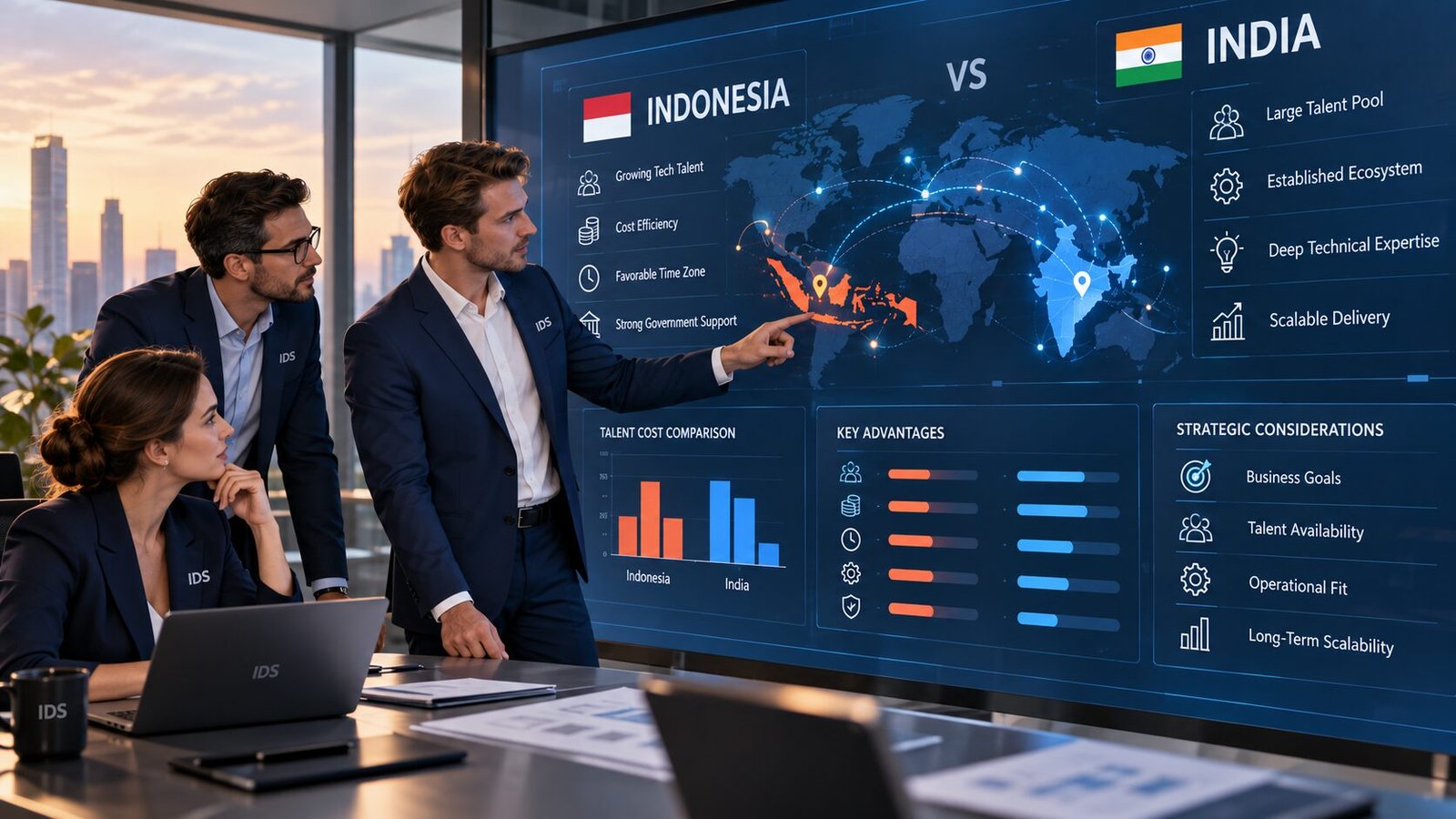

Offshore software development Indonesia gives global companies a practical way to expand engineering capacity, build custom applications, and access competitive development economics without creating every technical role internally. Indonesia can be particularly relevant for businesses in Australia, Singapore, Malaysia, New Zealand, the UK, Europe, and other international markets looking for a flexible technology partner.
IDSCORP, officially PT Inovasi Digital Sadajiwa, is an Indonesia-based technology company providing custom software development, application development, artificial intelligence solutions, automation, data and analytics, enterprise integration, and managed technology services. Its service portfolio is designed for organisations that require technology aligned with business processes rather than generic software alone.
Indonesia’s broader technology ecosystem is also expanding. GitHub’s 2025 Octoverse reported approximately 4.37 million developers in Indonesia, up from about 0.9 million in 2020. The World Bank also described Indonesia’s digital economy as the largest in ASEAN by gross merchandise value in 2025, while highlighting continued investment and digital infrastructure development.
For international businesses, the opportunity is not simply about finding lower hourly rates. The more important question is whether an Indonesia-based development partner can deliver the right combination of technical capability, governance, communication, scalability, security, and total project value.
Table of Contents
- What Is Offshore Software Development Indonesia?
- Why Offshore Software Development Indonesia Can Be Cost-Efficient
- What Does Offshore Software Development Indonesia Cost?
- Offshore Software Development Engagement Models
- How an Offshore Software Project Should Work
- How to Choose a Software Development Partner in Indonesia
- Why Global Companies Can Work with IDSCORP
- Frequently Asked Questions About Offshore Software Development Indonesia
- Conclusion
What Is Offshore Software Development Indonesia?
Offshore software development Indonesia means engaging a software company or engineering team based in Indonesia to build, maintain, integrate, or enhance software for a business located in another country. The client retains its business ownership and objectives while the Indonesian development partner provides some or all of the technical delivery capability.
The arrangement can cover an entire application or only a specific engineering function.
Typical projects include:
- Custom business applications
- Web applications
- Mobile applications
- Enterprise platforms
- Internal workflow systems
- Management dashboards
- Customer and partner portals
- APIs and system integrations
- Legacy application modernisation
- Artificial intelligence integration
- Business process automation
- Application maintenance
- Dedicated software development teams
Offshore development does not necessarily mean transferring complete control of a technology project to another company.
A CTO may keep architecture and product ownership internally while adding Indonesian frontend and backend developers. A startup may outsource an entire MVP. An enterprise may assign a defined system integration project to an external team while its internal IT department manages governance.
The right model depends on the organisation’s existing capabilities.
[GAMBAR: International product and engineering teams collaborating remotely with an Indonesia-based software development team through sprint planning, code review, dashboards, and video collaboration.]
FILE NAME:
indonesia-offshore-software-team-collaboration.webp
IMAGE TITLE:
International Collaboration with Indonesian Software Developers
ALT:
International company collaborating with an offshore software development Indonesia team
CAPTION:
A structured offshore model combines remote engineering capacity with clear product ownership, documentation, and delivery governance.
Why Offshore Software Development Indonesia Can Be Cost-Efficient
Offshore software development Indonesia can be cost-efficient when companies optimise total engineering capacity rather than simply searching for the lowest developer rate. The potential advantages include competitive development economics, strong APAC working-hour overlap, a growing developer community, flexible team structures, and access to custom software and AI capabilities.
Here are seven factors worth considering.
1. Competitive Development Economics
Software development costs are influenced by more than developer salaries.
A realistic calculation includes:
- Recruitment
- Employee benefits
- Engineering management
- Equipment
- Software licences
- Office and infrastructure costs
- DevOps
- Quality assurance
- Training
- Employee turnover
- Project management
- Compliance
- Ongoing support
For companies operating in higher-cost labour markets, working with an Indonesia-based team can create a more competitive delivery structure.
That does not mean every Indonesian development company will automatically be less expensive or deliver better value.
Senior engineering expertise, specialised AI skills, cybersecurity requirements, complex integrations, and enterprise-grade governance can significantly affect project pricing.
The right comparison is therefore total delivery value, not the cheapest hourly rate.
A project that requires extensive rework is rarely cost-efficient, regardless of the initial quote.
2. Strong Working-Hour Alignment with Asia-Pacific Markets
Indonesia is particularly practical for organisations in Asia-Pacific.
Jakarta operates at UTC+7 throughout the year. Singapore and Kuala Lumpur operate at UTC+8, while Sydney is typically several hours ahead depending on daylight saving arrangements. This creates substantial same-day working-hour overlap for many Australian and Southeast Asian businesses.
For Singapore and Malaysia, the difference from Jakarta is only one hour.
This can make activities such as the following easier to coordinate:
- Daily stand-ups
- Sprint planning
- Design reviews
- Requirement workshops
- User acceptance testing
- Incident escalation
- Deployment coordination
- Product demonstrations
For Australian companies, the working day can also overlap significantly with Indonesia, particularly when an Indonesian team adopts client-aligned schedules.
European and UK organisations have less conventional working-day overlap, but structured asynchronous development can still work through written specifications, issue tracking, documented decisions, and planned overlap windows.
US-based organisations may use a more asynchronous model, with development continuing during part of the client’s overnight period.
3. A Large and Growing Developer Ecosystem
Indonesia has a substantial technology talent base.
GitHub reported approximately 4.37 million developers in Indonesia in 2025, compared with roughly 0.9 million in 2020. This does not mean every GitHub account represents an available professional software engineer, but it does illustrate the scale and rapid growth of Indonesia’s developer ecosystem.
Indonesia is also continuing to invest in its digital talent pipeline.
In February 2026, Indonesia’s Ministry of Communication and Digital Affairs stated that the country is projected to require around 12 million digital talents by 2030, with a current gap of around three million. Government programmes are targeting areas including coding, AI, cybersecurity, cloud computing, and other digital skills.
For international buyers, however, country-level talent statistics should never replace vendor-level due diligence.
Evaluate the actual engineers who will work on your project.
4. Flexible Engineering Capacity
A company does not always need to hire ten permanent developers simply because a project temporarily requires ten developers.
Offshore development allows capacity to be structured around the project.
For example, a client may require:
- One business analyst during discovery
- A UI/UX designer during product design
- Two frontend developers during implementation
- Two backend developers
- A mobile developer
- A QA engineer
- Part-time DevOps support
- A project manager
When the application enters maintenance, the required team may become much smaller.
A flexible development model can therefore make engineering resources more closely match actual delivery requirements.
5. Broad Custom Software Capabilities
Indonesia’s software sector is not limited to website development.
Development partners can support projects involving:
- React, Vue, Angular, or other frontend frameworks
- PHP, Laravel, Node.js, Java, Python, .NET, Go, and other backend stacks
- Native and cross-platform mobile applications
- REST and GraphQL APIs
- Cloud infrastructure
- Database architecture
- Enterprise application integration
- Data pipelines
- Dashboards and analytics
- Workflow automation
- Artificial intelligence
- Machine learning
- Generative AI integration
The important point is not whether a vendor publishes a long technology list.
Buyers should confirm whether the proposed team has experience with the architecture, scalability, security, integrations, data model, and operational requirements relevant to the actual project.
6. A Growing Digital Business Environment
Indonesia’s technology capabilities are developing alongside a large domestic digital economy.
The World Bank reported that Indonesia’s digital economy remained the largest in ASEAN by gross merchandise value in 2025. It also highlighted expanding internet adoption and local data centre capacity, while noting that infrastructure quality and access remain uneven and require further development.
That distinction matters.
Indonesia should not be positioned as a flawless technology market. It is a large and rapidly developing digital ecosystem with both opportunities and infrastructure challenges.
For software outsourcing, the relevant benefit is access to engineering teams operating inside a market with significant demand for digital platforms, fintech, enterprise systems, AI, logistics technology, e-commerce, government technology, and business automation.
7. Enterprise Data and Deployment Options
International software projects increasingly involve data governance.
Indonesia has a national personal data protection framework under Law No. 27 of 2022 on Personal Data Protection, covering personal data processing and establishing responsibilities for data controllers and processors.
A development contract should still define project-specific requirements such as:
- Data access
- Source-code ownership
- Intellectual property assignment
- Repository permissions
- Development and production environments
- Backup procedures
- Authentication
- Logging
- Incident response
- Encryption
- Third-party services
- Data location
- Retention rules
- Production credentials
International clients may also have obligations under regulations in their own jurisdictions.
For sensitive workloads, architecture can include private cloud, on-premise infrastructure, isolated environments, or hybrid deployment depending on project requirements.
IDSCORP’s PRIVAI offering, for example, is designed around local or on-premise AI processing for organisations that require greater control over sensitive data.
[GAMBAR: Business infographic showing the seven benefits of software development in Indonesia: cost structure, APAC timezone, developer ecosystem, flexible teams, software capabilities, digital economy, and data governance.]
FILE NAME:
offshore-software-development-indonesia-benefits.webp
IMAGE TITLE:
7 Benefits of Offshore Software Development in Indonesia
ALT:
Seven benefits of offshore software development Indonesia for international businesses
CAPTION:
Indonesia can provide a combination of engineering capacity, regional alignment, flexible engagement, and expanding digital capabilities.
What Does Offshore Software Development Indonesia Cost?
The cost of offshore software development Indonesia depends on scope, engineering seniority, architecture, integrations, security, team composition, and engagement model. There is no responsible universal percentage that every company can expect to save by moving development to Indonesia.
A simple internal dashboard and a regulated enterprise platform should not be priced using the same assumptions.
Important cost drivers include:
| Cost Factor | Why It Matters |
|---|---|
| Scope complexity | More workflows, modules, roles, and business rules increase engineering effort |
| Team seniority | Senior engineers and specialised architects command higher rates |
| Technology stack | Specialist platforms or legacy technology may require rarer skills |
| Integrations | ERP, payment, CRM, identity, IoT, and third-party APIs increase complexity |
| Security requirements | Penetration testing, audit requirements, access controls, and private deployment add work |
| UI/UX complexity | Custom interaction design requires more product and design effort |
| Data migration | Cleaning, mapping, validating, and transferring existing data can become a major workstream |
| AI requirements | Model integration, RAG, evaluation, guardrails, inference infrastructure, and monitoring affect cost |
| QA requirements | Automated testing, performance testing, and device testing increase quality assurance effort |
| Support model | SLA, monitoring, maintenance, and enhancement requirements affect long-term cost |
A better procurement question is:
What business outcome and engineering capacity will this budget buy?
Ask vendors to separate estimates into areas such as discovery, design, engineering, QA, deployment, third-party infrastructure, maintenance, and optional enhancements.
This makes proposals easier to compare.
IDSCORP has also published a broader guide to factors affecting software development costs in Indonesia. Software development cost guide from IDSCORP
Offshore Software Development Engagement Models
An offshore project can be structured as end-to-end development, a dedicated team, a project-based engagement, or additional development support. The best model depends on how much product ownership, architecture, and delivery management already exists inside the client’s organisation.
| Engagement Model | Client Typically Owns | Development Partner Typically Provides | Best Fit |
|---|---|---|---|
| End-to-End Development | Business goals, approvals, key decisions | Discovery, architecture, UI/UX, development, QA, deployment | Companies needing a complete application |
| Dedicated Development Team | Product roadmap and priorities | Long-term engineers and delivery capacity | Companies scaling an existing product team |
| Project-Based Development | Requirements and acceptance | Delivery of a defined platform, module, or application | Projects with clear scope and milestones |
| Development Support | Existing product and technical direction | Specific engineering skills or additional capacity | Internal teams with temporary capability gaps |
End-to-End Software Development
This model is appropriate when the client wants one technology partner to manage most of the delivery lifecycle.
Possible scope includes:
- Requirement analysis
- Business analysis
- Solution architecture
- UI/UX design
- Frontend development
- Backend development
- Mobile development
- API development
- Database implementation
- Quality assurance
- Deployment
- System integration
- Maintenance and enhancement
Dedicated Development Team
A dedicated team operates as an extension of the client’s technology organisation.
Roles can include:
- Frontend developers
- Backend developers
- Full-stack developers
- Mobile developers
- QA engineers
- UI/UX designers
- Business analysts
- Project managers
- DevOps engineers
- AI engineers
- Technical support
This model works particularly well when the product roadmap will continue evolving and requirements cannot be completely fixed upfront.
Project-Based Development
Project-based development focuses on a defined application, platform, module, integration, or modernisation initiative.
Milestones, deliverables, acceptance criteria, and change-management rules should be agreed before development begins.
Development Support
Some organisations already have strong internal engineering leadership but need additional capacity.
An external team can support:
- Frontend implementation
- Backend services
- API integration
- Mobile applications
- Module development
- Quality assurance
- Bug fixing
- Legacy modernisation
- AI integration
- DevOps
- Technical maintenance
How an Offshore Software Project Should Work
Successful offshore development requires more than transferring requirements to remote developers. It needs structured discovery, documented decisions, visible delivery progress, testing, security controls, and clear responsibility between the client and development partner.
A practical delivery process can follow seven stages.
1. Discovery and Requirement Analysis
Start with the business problem.
Document:
- Who will use the system?
- What process does it improve?
- What data does it use?
- Which systems must it integrate with?
- What approvals are required?
- What problems exist today?
- What business outcome should improve?
2. Solution Architecture
The development team translates requirements into a technical structure covering applications, APIs, databases, integrations, environments, authentication, infrastructure, and security.
3. Product and UI/UX Design
Wireframes and interface flows help stakeholders validate how the product should work before significant engineering effort begins.
4. Sprint Planning and Development
Development can then proceed incrementally.
Regular demonstrations allow stakeholders to review working functionality rather than waiting until the end of the project.
5. Integration and Data Work
APIs, external systems, legacy applications, identity services, data migration, or AI services should be integrated and tested systematically.
6. QA, Security, and User Acceptance Testing
Testing should cover more than whether a button works.
Depending on the application, testing may include:
- Functional testing
- Regression testing
- API testing
- Cross-device testing
- Performance testing
- Role and permission testing
- Security testing
- User acceptance testing
7. Deployment and Continuous Improvement
Production deployment should include documentation, environment configuration, monitoring, backup procedures, and ownership handover.
Applications rarely remain unchanged after launch.
Business processes evolve, user feedback creates new requirements, integrations change, and security updates continue.
Plan maintenance before go-live rather than treating it as an afterthought.
[GAMBAR: Seven-stage software development lifecycle diagram showing Discovery → Architecture → UI/UX → Development → Integration → QA & UAT → Deployment & Improvement.]
FILE NAME:
offshore-software-development-process-indonesia.webp
IMAGE TITLE:
Offshore Software Development Process in Indonesia
ALT:
Offshore software development Indonesia seven-stage project delivery process
CAPTION:
A structured delivery lifecycle gives international clients visibility from discovery through deployment and ongoing improvement.
How to Choose a Software Development Partner in Indonesia
Choosing an offshore partner should focus on delivery capability, communication, governance, architecture, security, and relevant experience. Country-level cost advantages cannot compensate for weak engineering processes or unclear accountability.
Use the following checklist.
1. Ask Who Will Actually Build the Software
Do not evaluate only the sales presentation.
Understand:
- Team composition
- Seniority
- Technical leadership
- Project management
- QA resources
- Availability
- Whether work will be subcontracted
2. Review Relevant Project Experience
A vendor does not need to have built the exact same product before.
However, relevant experience with similar complexity can significantly reduce risk.
Look for familiarity with:
- Enterprise workflows
- Integrations
- High-volume data
- Field applications
- Regulated environments
- Multi-role systems
- AI
- Mobile applications
- Dashboards
3. Evaluate Communication
English capability can vary significantly between individuals and companies, just as it does in any international market.
Evaluate the actual project manager, business analyst, and technical lead who will communicate with your organisation.
Good remote communication includes:
- Written requirements
- Meeting notes
- Decision logs
- Sprint boards
- Technical documentation
- Risk escalation
- Regular product demonstrations
4. Clarify Intellectual Property
The contract should clearly define:
- Source-code ownership
- Design ownership
- Third-party components
- Open-source licences
- Repository access
- IP transfer
- Confidentiality
- Rights after termination
5. Review Security Practices
Ask how the vendor handles:
- Access control
- Password and secret management
- Development environments
- Production access
- Logging
- Backups
- Vulnerability management
- Data exports
- Employee access
- Offboarding
6. Understand Change Management
Requirements change.
The contract should explain what happens when they do.
A mature project process distinguishes between:
- Clarification
- Defect
- Enhancement
- New requirement
- Change request
This prevents commercial disputes later.
7. Review QA Before Signing
Ask who is responsible for testing.
Developers testing their own functionality should not be the only quality-control process for an important application.
8. Discuss Post-Launch Support
Define what happens after go-live.
Questions should cover:
- Warranty period
- Bug handling
- Response times
- Infrastructure monitoring
- Application maintenance
- Security updates
- Minor improvements
- New feature development
9. Start with Discovery When Requirements Are Unclear
Do not force a fixed project quote from incomplete requirements.
A short discovery or technical assessment can reduce uncertainty before a larger build begins.
10. Consider a Defined Initial Phase
When evaluating a new offshore relationship, a bounded first phase can help both parties validate communication, engineering quality, workflow, and delivery discipline before scaling the engagement.
Why Global Companies Can Work with IDSCORP
IDSCORP combines software development with consulting, AI, data, integration, and managed technology capabilities, allowing international clients to use the company for either complete application development or specific technical workstreams.
IDSCORP, officially PT Inovasi Digital Sadajiwa, describes its core service portfolio as:
- IT Consulting & Advisory
- Artificial Intelligence Solutions
- Software Development
- Data & Analytics Solutions
- Enterprise Integration & Infrastructure
- IT Talent & Managed Services
International clients can explore IDSCORP’s existing software development content and capabilities through its Software Development resources, Custom Digital Solution overview, Artificial Intelligence Solutions, and Enterprise Integration & Infrastructure overview.
IDSCORP’s public portfolio describes software work across operational systems, compliance applications, analytics, monitoring, and artificial intelligence. Examples published by the company include a digital inspection system for Pertamina, a hazardous-waste management application for PLN, and Reputifai, an AI-powered media monitoring and sentiment analysis platform. These examples demonstrate experience with workflows, dashboards, data, approvals, operational monitoring, and enterprise environments.
For organisations that need AI alongside traditional application development, IDSCORP also provides AI implementation capabilities and PRIVAI, its private and local AI offering designed for environments where organisations want greater control over sensitive information.
The most appropriate engagement should still begin with the project itself.
Instead of selecting technology first, define:
- The business problem
- Required users
- Critical workflows
- Existing systems
- Data requirements
- Security constraints
- Required integrations
- Success criteria
- Budget expectations
- Target timeline
The development model can then be designed around those requirements.
Frequently Asked Questions About Offshore Software Development Indonesia
Is Indonesia a good location for offshore software development?
Yes, Indonesia can be a practical offshore software development location, particularly for businesses seeking APAC time-zone alignment, flexible engineering resources, custom application capabilities, and competitive development economics. Indonesia also has a rapidly expanding developer ecosystem. GitHub reported around 4.37 million developers in the country in 2025.
Is offshore software development in Indonesia cheaper than local development?
It can be more cost-efficient for companies operating in higher-cost markets, but there is no universal saving percentage. Pricing depends on seniority, scope, architecture, security, integrations, management, and engagement model. Compare total project cost and expected delivery quality rather than choosing a vendor solely because it offers the lowest hourly rate.
Is Indonesia suitable for Australian software development projects?
Indonesia can be particularly convenient for Australian organisations because working hours overlap substantially. Jakarta operates at UTC+7, while major Australian cities operate several hours ahead depending on location and daylight saving. This makes real-time stand-ups, demonstrations, UAT, and issue resolution practical for many projects.
Is Indonesia suitable for companies in Singapore and Malaysia?
Yes. Jakarta is only one hour behind Singapore and Kuala Lumpur, which makes full working-day collaboration relatively straightforward. This can be useful for dedicated development teams, continuous application development, integration projects, and ongoing support arrangements.
What software can an Indonesian offshore team build?
Depending on the vendor’s capabilities, projects can include web applications, mobile apps, internal enterprise applications, dashboards, workflow systems, APIs, integrations, customer portals, data platforms, automation systems, AI applications, legacy system modernisation, and application maintenance.
Should I choose a dedicated team or project-based development?
Choose a dedicated team when requirements evolve continuously and you need long-term engineering capacity. Choose project-based development when the application or module has a reasonably defined scope, timeline, and acceptance criteria. Companies can also combine both models, starting with a project and retaining a smaller dedicated team after launch.
How should intellectual property be handled?
Intellectual property terms should be explicitly documented in the development agreement. The contract should identify ownership of source code, designs, project documentation, custom components, third-party software, repositories, and deliverables. International businesses should obtain appropriate legal advice for cross-border contractual requirements.
How is personal data handled in Indonesia?
Indonesia regulates personal data through Law No. 27 of 2022 on Personal Data Protection. International clients should additionally evaluate their own jurisdictional requirements and specify project-level controls for access, processing, storage, retention, security, and cross-border data handling.
Conclusion: Is Offshore Software Development Indonesia Right for Your Business?
Offshore software development Indonesia can be a strong option for organisations that need additional engineering capacity, custom software, application development, system integration, AI capabilities, or a flexible remote technology team.
Its value should not be reduced to labour cost alone.
The stronger business case combines competitive development economics with a growing developer ecosystem, APAC working-hour compatibility, scalable engagement models, enterprise software capabilities, and structured project governance.
Companies should still evaluate vendors individually.
Review the actual engineering team, communication process, security approach, project methodology, relevant experience, intellectual-property terms, quality assurance process, and post-launch support before making a decision.
Planning a software project or looking for a development team that can extend your existing engineering capabilities?
IDSCORP can help you evaluate your requirements and identify a practical, cost-efficient software development approach from Indonesia.
━━━━━━━━━━━━━━━━━━━━━━━━━━━━━━━━
CONTACT IDSCORP
━━━━━━━━━━━━━━━━━━━━━━━━━━━━━━━━
Have a software, application, or AI integration project in mind? Contact IDSCORP to discuss your requirements with our technology team.
PT Inovasi Digital Sadajiwa (IDSCORP)
Website:
IDSCORP official website
Email:
info@idscorp.id
Phone / WhatsApp:
+62 819-9913-6511
Instagram:
@halo.idscorp
#IDSCORP
#IDSCorpID
#InovasiDigitalSadajiwa
#SoftwareDevelopment
#CustomSoftware
#ApplicationDevelopment
#SoftwareOutsourcing
#OffshoreDevelopment
#OffshoreSoftwareDevelopment
#DedicatedDevelopmentTeam
#SoftwareDevelopmentIndonesia
#AIIntegration
#EnterpriseSoftware
#DigitalTransformation
#IndonesiaTech